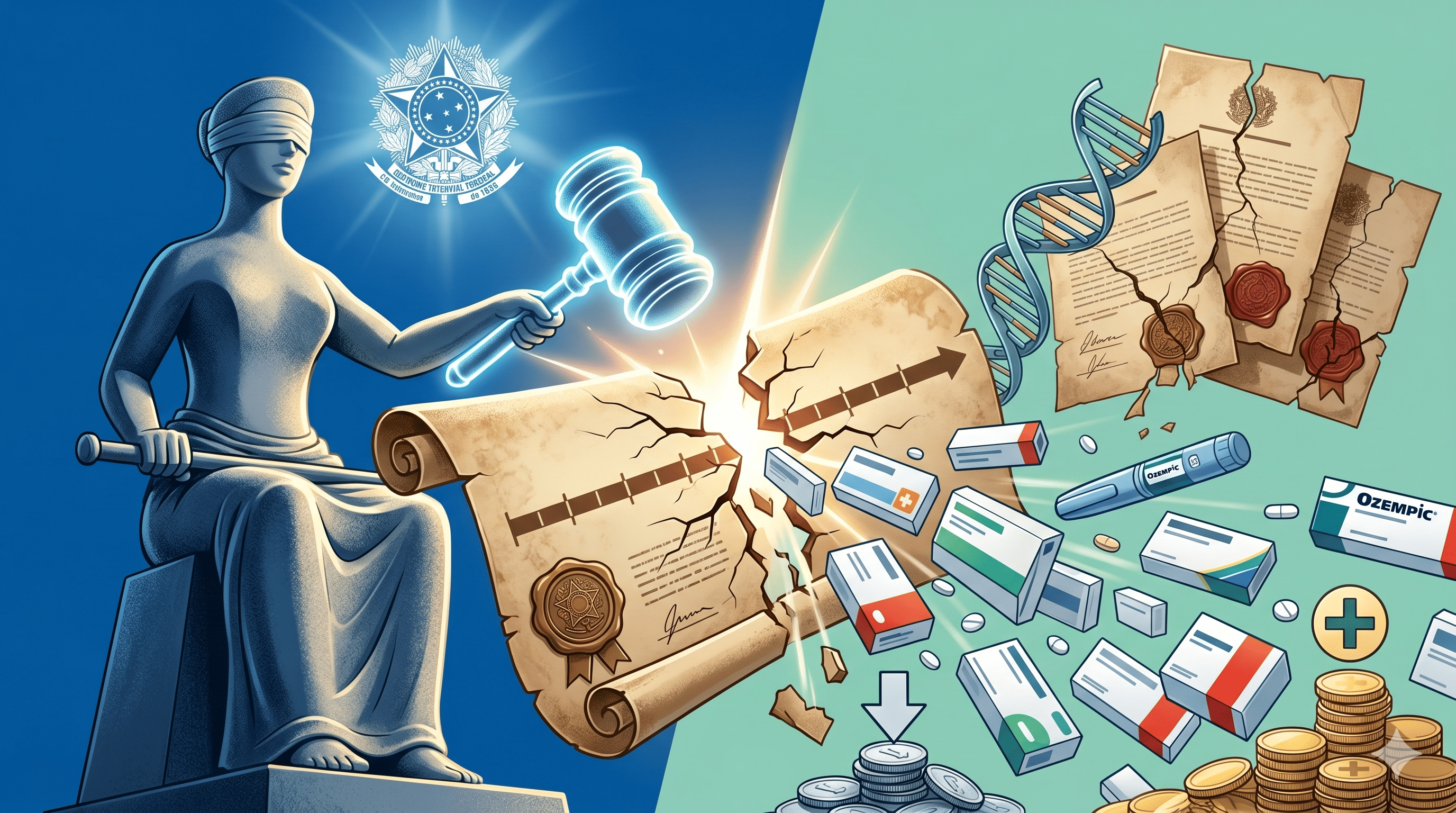
On May 6, 2021, the Supreme Federal Court declared the sole paragraph of article 40 of the Industrial Property Law (Law 9,279/1996) unconstitutional. The decision ended a mechanism that, in practice, automatically extended pharmaceutical patents beyond the 20 years provided for in international agreements — and paved the way for the entry of generics into dozens of markets.
What the Overturned Provision Stated
The sole paragraph of article 40 guaranteed a minimum term of 10 years of validity from the date of the invention patent’s grant (7 years for utility models). On the surface, it seemed like just protection for the patent holder. In practice, it was an automatic extension mechanism: since the INPI took, on average, more than a decade to examine applications, a patent filed in 1997 and granted in 2011 would be valid until 2021 — not until 2017, as stipulated by the 20-year rule from the filing date.
The INPI presented data to the Supreme Court illustrating the extent of the problem: 8,837 applications pending for more than 10 years and an average decision time of up to 14 years in some technological groups. ABIFINA, author of the original lawsuit (ADI 5061/2013), documented that the provision had been invoked in 96% of pharmaceutical patents granted between 2000 and 2016.
Which Patents Were Affected
The decision was approved by 9 votes to 2 (rapporteur Min. Dias Toffoli). The modulation of effects, approved by 8 to 3, established a general rule ex nunc (without retroactivity), but with a relevant exception: pharmaceutical patents, equipment and materials for health use had effects applied ex tunc (retroactively), as did all patents already subject to lawsuits until 04/07/2021.
The INPI published an initial list of 3,341 patents for immediate correction or extinction in RPI 2628 of 05/18/2021, with subsequent weekly lists. Law 14,195/2021, enacted in August of the same year, expressly revoked the sole paragraph of the LPI.
Estimated Economic Impact
The potential impact was calculated by different sources using distinct methodologies:
| Source | Estimate | Scope |
|---|---|---|
| Ministry of Health (ADI records) | R$ 1.6 billion | Conservative |
| GEI/IE/UFRJ | R$ 3.8 billion (SUS) + R$ 1.7 billion in lawsuits | 97.8% in 5 active ingredients |
| FarmaBrasil/UFRJ | R$ 7.6 billion (private market) + R$ 1.1 billion (SUS) | Scenario with maintenance of 62 patents in litigation |
Concrete cases confirmed the scale of the impact. Bilastine (antihistamine) had a generic launched 35% cheaper after the ADI. For rivaroxaban (Xarelto, Bayer), Min. Fux declared valid the production of the EMS generic in the interval between the patent’s expiration and the publication of the STF’s decision — which includes a period of almost three years of undue validity.
What Is Still Under Dispute
|The ADI did not end the debate. After the decision, manufacturers of innovative medicines began filing individual lawsuits claiming Patent Term Adjustment (PTA) — a casuistic compensation mechanism for the time the INPI took to examine each application. The logic: the ADI would have only overturned the automatic and abstract extension, not the possibility of individual adjustment due to administrative delay.
The STJ ended this judicial discussion in December 2025 in the semaglutide (Ozempic) case, but the debate migrated to Congress, where Bill 5,810/2025 proposes creating an administrative PTA mechanism at the INPI with a 5-year extension limit.
The underlying issue remains the same that motivated the ADI: as long as the INPI takes years to examine pharmaceutical applications — and the specific backlog in this sector has never been tackled with the same energy as the general one — the tension between innovation and access to medicines will continue to produce litigation.
Read also:
- Patent Term Adjustment: Big Pharma lost in court, but the debate reached Congress
- The INPI backlog is over — but not for drug patents
- Patent Term Adjustment: Big Pharma lost in court, but the debate reached Congress
You can get in touch to discuss this and other topics at [email protected]