In January 2026, the INPI discontinued the “backlogometer” — the public dashboard that monitored the reduction of the backlog of pending patent applications — with the justification that the project achieved its objective. For the general universe of applications, the statement is technically correct. For pharmaceutical patents, the reality is quite different.
What was the Backlog Combat Plan
Launched in July 2019 by INPI/PR Resolutions No. 240 and 241, the plan started with a backlog of 149,912 pending applications filed until 2016. The central strategy was to use prior art searches already conducted by foreign offices (USPTO, EPO) to issue preliminary requirements (dispatch 6.21), forcing the applicant to respond within 90 days or have the application dismissed.
The results were significant: a 55% reduction in the backlog by March 2021 and the achievement of the official 80% target by the end of the same year. The technical staff was reinforced with 210 new examiners and automated search tools.
The blind spot: pharmaceuticals were left out
Pharmaceutical applications subject to art. 229-C of Law 9,279/1996 (LPI) — which required prior ANVISA approval until its extinction by Law 14,195/2021 — were explicitly excluded from the Plan. This exclusion has practical consequences to this day: a survey by Interfarma indicates an average time of 10.25 years between filing and grant for biopharmaceuticals in the 2020-2022 period, compared to a general average that dropped to approximately 4 years after the plan.
The total residual backlog of the INPI still exceeds 115 thousand pending applications, according to the December 2024 IP Monthly Bulletin.
What changes with Ordinance No. 110/2025
Ordinance GM/MDIC No. 110/2025, signed on 05/05/2025 and published in the DOU on 09/05/2025, institutes the update to the Table of Fees - a document that lists all services provided by the INPI. The changes do not institute automatic grant without substantive examination — a narrative that circulated mistakenly. According to art. 3, the issuance of the patent letter is now exempt from a separate petition. Previously, the applicant needed to file a petition, along with payment, from the decision to defer the patent application.
Art. 3, I:
a. Issuance of patent letter or certificate of addition of invention (petition waived) - within the ordinary term (code 212);
b. Issuance of patent letter or certificate of addition of invention (petition waived) - within the extraordinary term (code 213);
Now the applicant pays a single fee at the beginning that already includes the future issuance of the patent letter. In parallel, the average fee adjustment was 24.1%, with reductions of up to 60% for micro-enterprises, SMEs, and ICTs, and total exemption for CadÚnico beneficiaries and PwDs.
The ordinance does not alter the substantive examination procedure nor create exceptions for pharmaceutical applications.
Why this matters for those filing patents today
The drop in the volume of pharmaceutical decisions — from 6.4 thousand in 2021 to 2.6 thousand until September 2024, according to Interfarma’s survey reported by Futuro da Saúde — demonstrates a specific bottleneck in the sector. It is the predictable result of three structural factors that the Backlog Combat Plan did not address in the sector: chronic shortage of specialized examiners (only 23 in pharmaceuticals and 28 in biopharmaceuticals), increasing technical complexity of biotechnology applications, and the absence of acceleration mechanisms for this segment.
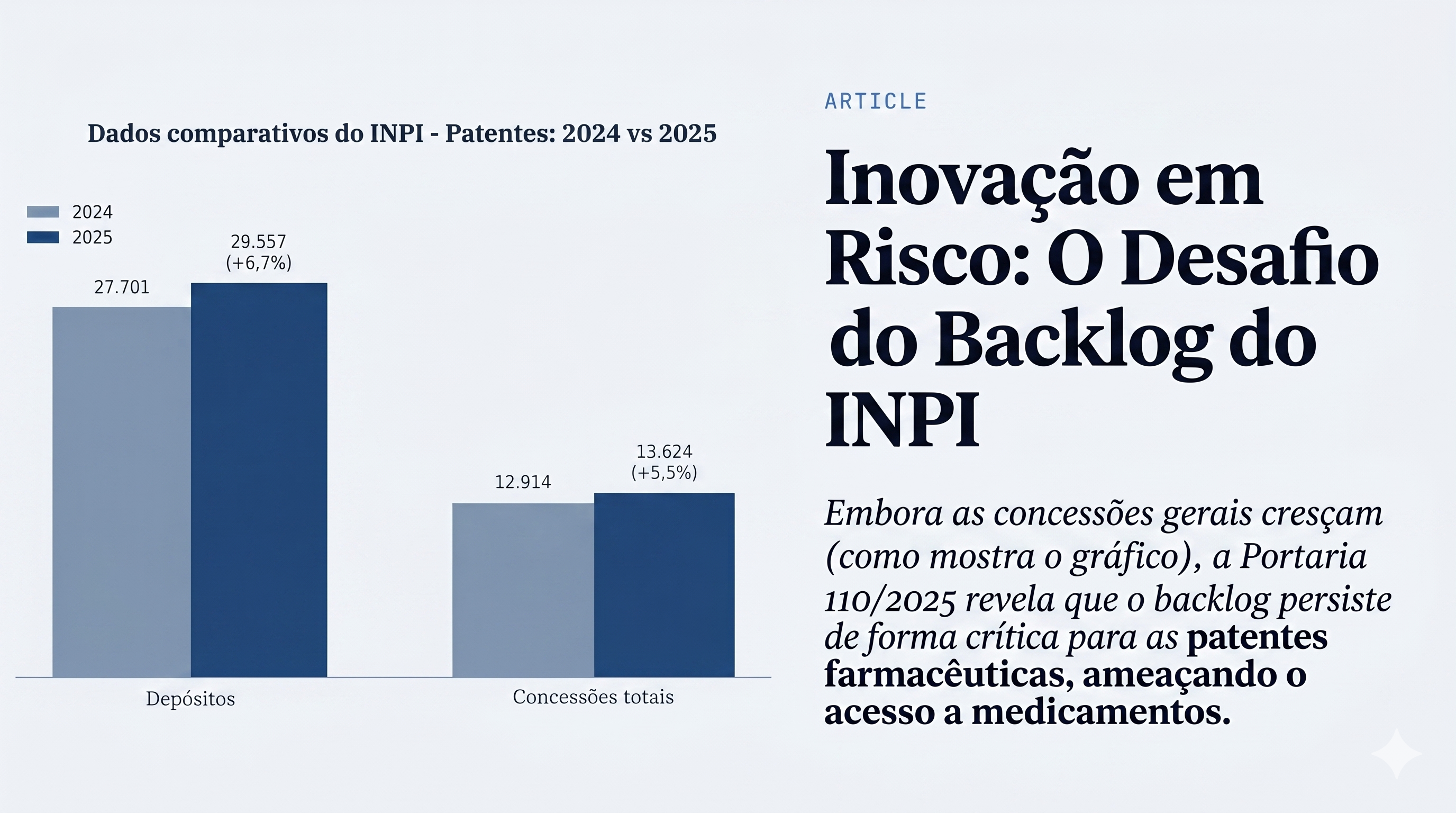
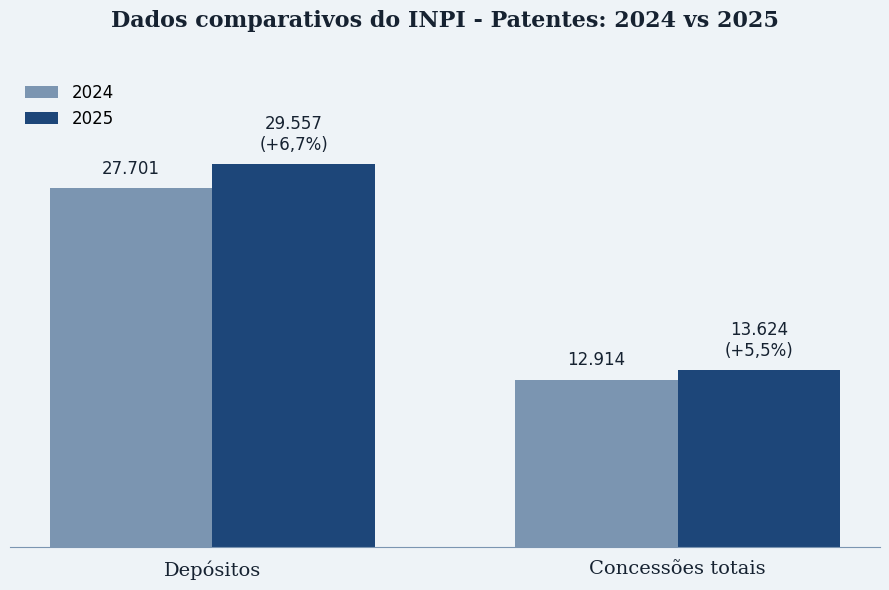
In 2025, data from the IDS IP Bulletin show partial recovery — filings rose 6.7% (29,557) and total grants grew 5.5% (13,624). Brazil surpassed the US as the largest origin of applications (26.2% vs 23.5%). These are positive signs and demonstrate an appetite for innovation in Brazil. However, the bottleneck observed in the pharmaceutical sector remains a challenge.
The automation that INPI plans for the 2025-2029 roadmap — including the use of AI as an examination assistant with a decision target within two years — could be the structural step that was missing from the original plan.
Meanwhile, the debate on how to compensate for historical delays in the effective term of pharmaceutical patents gained a new chapter in Congress through the discussion of Patent Term Adjustment (PTA), which aims to adjust the term of pharmaceutical patents based on the waiting time for obtaining the grant of the application by the INPI.
Read also:
- INPI’s Ambitious Automation Roadmap
- Patent Term Adjustment: Big Pharma lost in court, but the debate reached Congress
- Introduction to my new space on the internet
You can get in touch to discuss this and other topics at [email protected]