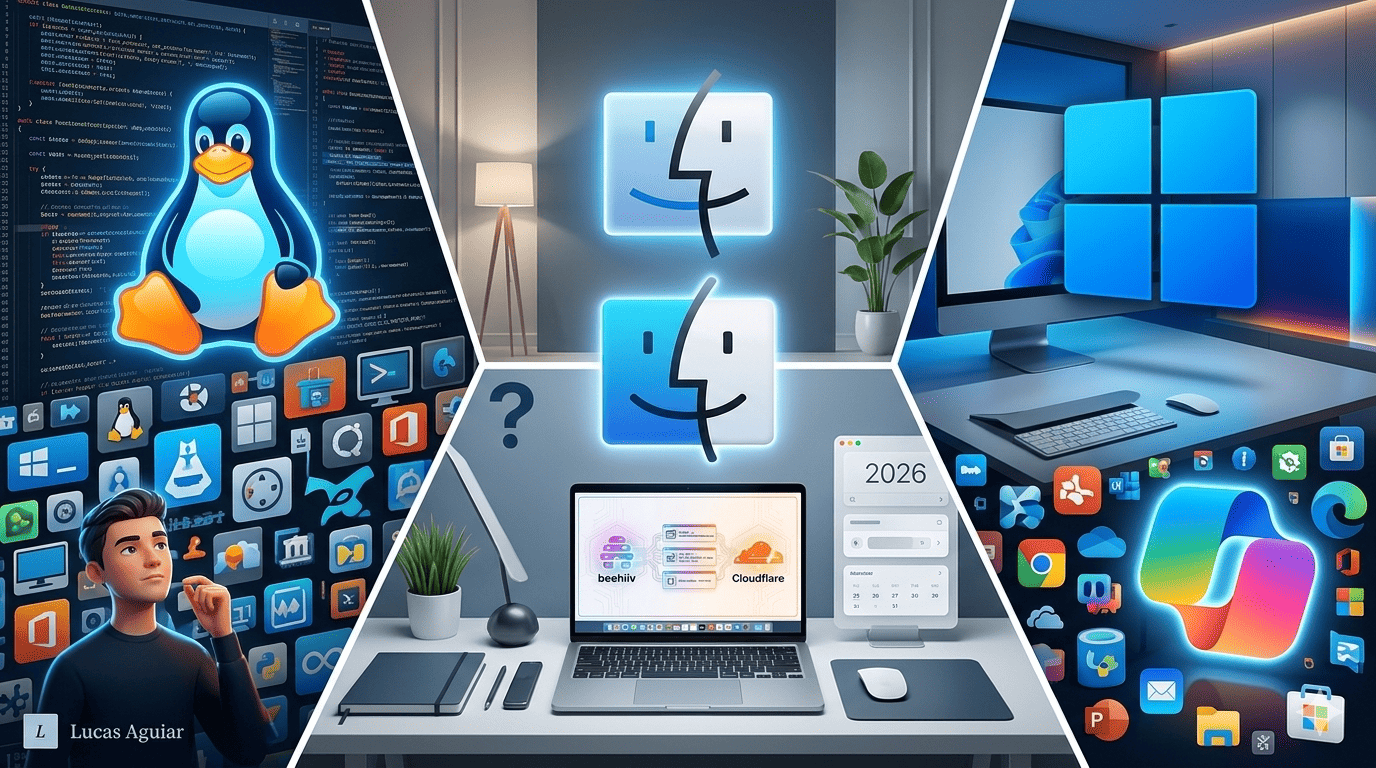
I got the idea for this text after learning from the channel Fireship about the latest exploit in the Linux kernel that was related to a 2017 commit. And last week, I was discussing with friends who work with data science why I prefer to stay away from Linux today.
Alright, but who am I to talk about this topic? I’ve been using macOS since mid-2007, without dual-booting with Windows until mid-2010. After that period, I primarily used Windows to run Microsoft Flight Simulator X, until I eventually returned to exclusively using macOS until mid-2018.
Starting in 2018, I became increasingly interested in computers and eventually started using Linux on an old MacBook that still turned on at the time. This MacBook was quite limited and, even then, wasn’t capable of running a light distro like Linux Mint with XFCE well. Later, I realized it was becoming difficult to continue using my MacBook Pro with macOS, which would soon lose support, so I decided to start using Linux full-time. This phase lasted until mid-2022, when I bought my MacBook Air M2.
As is the case for many macOS or Linux users, for almost all this time I continued to have contact with Windows, mainly at work. And I currently use Windows 11 daily. That said, I believe I can share my perspective as a user who genuinely uses these operating systems for daily tasks, who no longer plays online or offline games, and just wants a computer that is fully functional whenever it’s turned on. I believe this covers a good portion of these systems’ uses.
What I think about Linux
I think everyone should have some contact with Linux, simply because it’s not a seven-headed beast as it once was. However, I think people need to have this contact because it allows for a more complete experience — the user becomes much more aware of what’s behind each decision, especially after going through some tough spots.
The fact that Linux can become anything the user wants is extremely powerful and, at the same time, it’s exactly what makes a veteran know how to say “no” when they have the opportunity to use it daily. The veteran will have already gone through tough times in critical moments: had to deliver something important and the computer had problems because of the latest update. Often it’s something simple, but sometimes an innocent modification rendered the machine unusable. This kind of thing is very common in Linux.
Therefore, the first experience should always be on secondary machines, where it’s no problem if they crash. After you’ve tested several things, had to format the computer a few times, but still want to continue using Linux, choose a stable distro for daily use.
The best options in this regard, in my opinion, are:
- Ubuntu — the most popular, with a huge support and documentation base
- Linux Mint — excellent for those coming from Windows, familiar interface
- Zorin OS — focused on ease of use, good “out of the box” experience
- Fedora — well-regarded in the community
Regarding Fedora, my experience was very limited — I didn’t get to use it on a daily machine.
As for Arch Linux, I think the scenario is anarchic, to say the least. I cannot recommend Arch for daily use for anyone without advanced technical knowledge. It’s very difficult to depend on a system that has a new update every day. Ubuntu and company have the best balance between stability and package up-to-dateness — and that’s what matters for those who need to work.
Why I don’t use Linux
I don’t use Linux mainly due to a lack of optimization for most machines you would need to run it on. If the machine has Nvidia, you’ll have firmware problems. If it uses a Broadcom Wi-Fi card, you’ll have driver problems. Various problems you don’t even imagine exist, and that require workarounds to function.
Regarding the 2014 MacBook Pro I used, it was practically Russian roulette what would work. I had problems with heat sink regulation, keyboard backlight, Wi-Fi, webcam, OneDrive synchronization, and battery management, among others. And what I see in the future doesn’t look better, especially with the trend of soldering components onto machines and using as much proprietary hardware as possible. Asahi Linux, which I stopped following some time ago, demonstrates how difficult the adaptation is for Apple’s new chips. I would like to feel confident in a fully functional project like this, but I cannot have that confidence in the short term. I wrote more about homelab and Linux in another post — if you want to see what it’s like to deal with Linux in a virtualized environment, it’s worth reading.
For me, who depends on a computer working 100% every time I turn it on, I cannot trust any of these projects on my main computer.
What about Windows?
On this front, I have good and bad things to say. The computer I currently use at work is very capable, so in terms of performance, Windows 11 runs excellent and I’ve never had problems. I like some things in Windows Explorer that don’t exist in macOS — and honestly, that’s basically it. The main negative points are related to the bloat that Microsoft insists on putting into its products: advertising campaigns within the system itself, and Copilot everywhere, but with very limited usability.
Why I use macOS
The main advantage of macOS lies in the confidence in the hardware I’m running, not so much in the software. My experience with Apple products over the last 15 years has been very positive — no serious problems. And today, knowing the product’s ability to maintain performance for many years, this was crucial for my choice of the MacBook Air M2.
I know I can keep it without problems for at least 5 years, without thinking about replacing it. I wrote more about this in detail in the post about 10 years with MacBook — the real longevity of this hardware is impressive. All experiences with Windows computers over the years have been much worse in this regard, and that’s basically a widely known fact.
Regarding software, I’m not a huge fan — I know what could be improved — but nothing I use daily does a bad job. The number of quality applications available on the App Store and other channels is also much higher than it was a few years ago.
I hope this text has helped you if you are considering these options. I aimed to provide my user opinion, with experiences and perspectives after years of using all three systems, instead of raw data about each of them.
Read also: