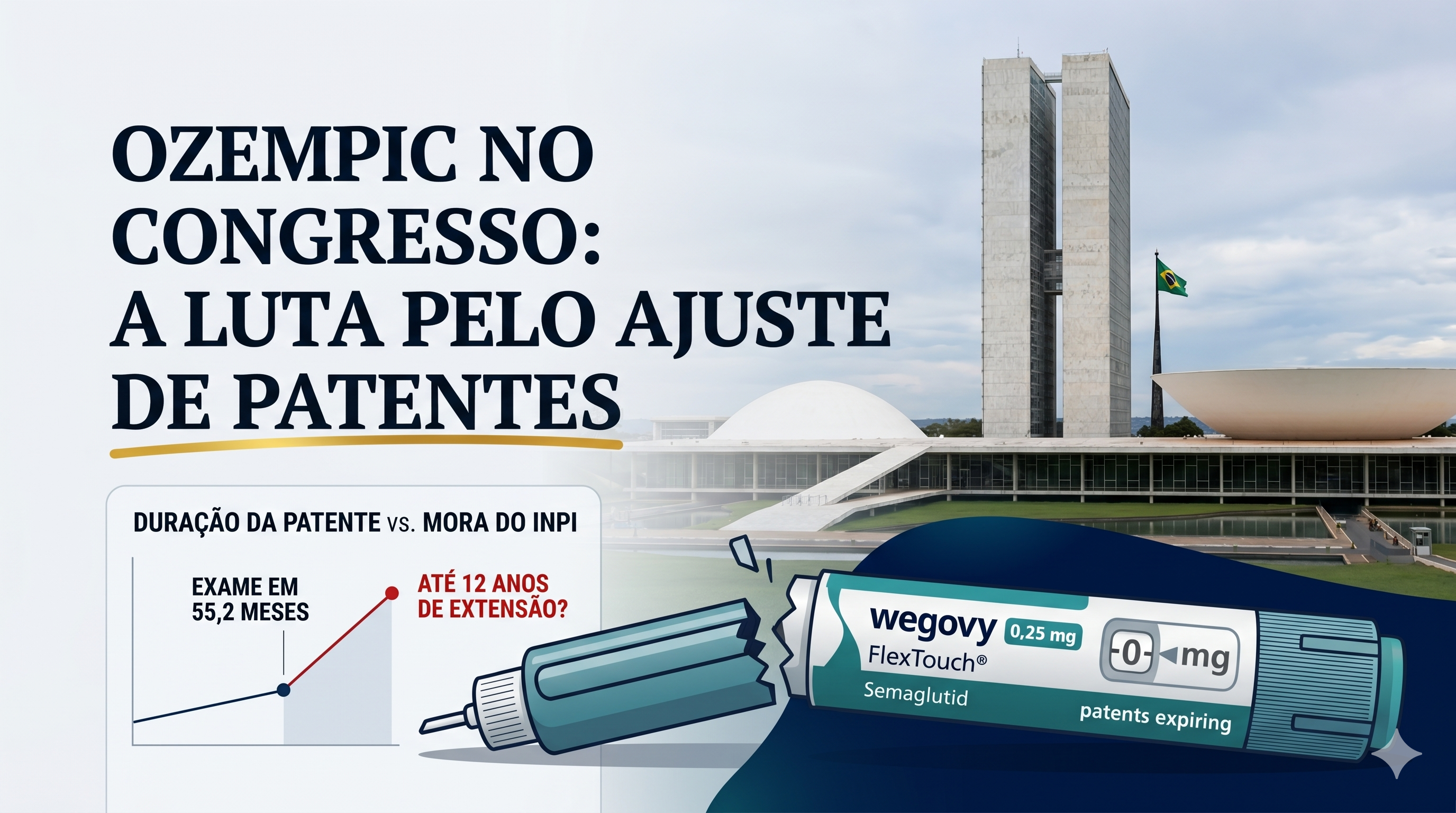
On December 16, 2025, the 4th Panel of the Superior Court of Justice concluded the most anticipated judicial discussion in the Brazilian pharmaceutical sector. Unanimously, the STJ denied the patent term adjustment for semaglutide patents (REsp 2.240.025/DF), ending Novo Nordisk’s attempt to extend Ozempic’s protection by up to 12 years beyond the anticipated expiration date.
The patent expired on March 20, 2026. But the debate didn’t end — it migrated to Congress.
What is Patent Term Adjustment and why it reached the courts
After ADI 5.529/DF, which overturned the automatic term extension based on the minimum validity period of article 40 of the IP Law, pharmaceutical patent holders began to appeal to the Judiciary with a different thesis: they were not requesting automatic extension, but case-by-case and proportional compensation for the time the INPI took to examine each specific application.
The argument had three pillars: (1) the ADI would have overturned only the generic extension, not the case-by-case one; (2) article 4 of the LINDB allows analogy in case of a legal gap; (3) article 62.2 of TRIPS requires that administrative procedures do not “consume” the protection period. Interfarma claims that the average time between examination request and first decision for biopharmaceuticals reached 55.2 months between 2010 and 2024.
The thesis rejected by the STJ
Reporting Justice Maria Isabel Gallotti summarized the STJ’s position in a phrase that should guide the legislative debate: “Brazil has no legal provision establishing objective criteria for this case-by-case extension” — and the Judiciary cannot create an administrative delay compensation mechanism without a law to support it.
Two days before the STJ’s decision, the TRF-1 had suspended a first-instance ruling that had granted an 8-year, 5-month, and 1-day adjustment to liraglutide (Saxenda, also from Novo Nordisk).
Here, in fact, it is possible to understand both arguments. On one hand, the INPI can argue that the IP Law does not provide a maximum term for the examination of a patent application. For this reason, the INPI took years to present a formal plan to combat the backlog of patent applications.
On the other hand, when we observe other administrative processes handled by other agencies, the processing of applications is subject to the deadlines dictated by Law 9.784/99 and even the LINDB. Therefore, considering that the patent application process is an administrative process, it makes no sense for the INPI not to be subject to the same deadlines, or, in the last instance, to specific deadlines, taking into account the complexity of patent analysis.
What Bill No. 5.810/2025 proposes
Bill No. 5.810/2025, presented in November 2025 by Representatives Capitão Alberto Neto, Dr. Zacharias Calil, and Mersinho Lucena, institutes an administrative process at the INPI for term adjustment with two central restrictions: a maximum limit of 5 years for extension and prohibition of adjustment when the holder contributed to the delay (such as when not responding to requirements within the deadline).
However, it is important to note how much the Bill is directed towards the pharmaceutical sector, as pharmaceutical companies are those that would benefit most from a term extension.
In a scenario of high investments in the development of a national pharmaceutical industry, this extension could disrupt the current momentum, in addition to generating legal uncertainty.
The proposal is awaiting a rapporteur in the Chamber’s Industry, Commerce, and Services Commission (CICS). In parallel, the Senate is discussing Bill No. 2.210/2022 (rapporteur: Senator Jacques Wagner), whose Amendment No. 4 introduces a similar mechanism.
The antagonistic positions
The cleavage is clear and reflects structurally opposed interests.
In favor (Interfarma, Novo Nordisk, big pharma): PTA exists in the USA, Chile, South Korea, Mexico, and Colombia. Without it, the time lost at the INPI consumes the commercially useful life of the patent even before the product reaches the market. Novo Nordisk, after the defeat at the STJ, declared support for “legislative modernization” via PTA.
Against (ABIFINA, FarmaBrasil, PróGenéricos, Aenda): in a joint technical note from February 2026, the entities classify PTA as an unconstitutional TRIPS-Plus mechanism that transfers the burden of administrative inefficiency to consumers and the SUS. The correct solution, they argue, is structural — more examiners, backlog reduction, automation tools. Economist Reginaldo Arcuri (FarmaBrasil) summarized: “The people lose.”
The estimated cost if the 62 term extension lawsuits were granted would be R$ 7.6 billion for the private market and R$ 1.1 billion for the SUS — calculated by FarmaBrasil and UFRJ.
What remains open
The fundamental question is simple to state, but difficult to resolve: if the INPI takes years to examine pharmaceutical patents — and the specific bottleneck in this sector has never been addressed with the same energy as the general backlog — who pays the cost of this delay?
Whose interest is it that the Brazilian patent system, especially for the pharmaceutical sector, continues in its current state - with long queues and few examiners?
The answer that comes from Congress will define the conditions for return on investments in pharmaceutical innovation in Brazil for decades. And it will do so in a context where Nova Indústria Brasil is investing R$ 57 billion precisely in building national innovative capacity — which places both sides of the debate in the same public policy ecosystem.
Also read:
- The INPI’s Backlog is Over — But Not for Pharmaceutical Patents
- INPI Automation Roadmap 2025-2029
- Introduction to my new space on the internet
Read also:
- The INPI backlog is over — but not for drug patents
- INPI’s Ambitious Automation Roadmap
- Introduction to my new space on the internet
You can get in touch to discuss this and other topics via email [email protected]